

Robotic Process Automation Market Expected to Grow at 26.1% CAGR and Hit USD 62.08 Billion
Robotic Process Automation Market
Robotic Process Automation (RPA) Market Size, Share and Research Report By Process (Decision Support, Automated Solution, and Management Solution)
Robotic Process Automation Market: Growing demand for workflow automation, cost optimization, and enhanced operational efficiency is fueling widespread adoption of robotic process automation.”
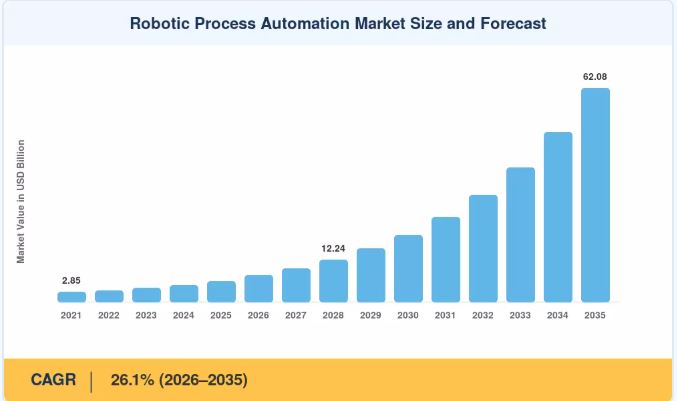
NEW YORK,, NY, UNITED STATES, August 6, 2026 /EINPresswire.com/ -- The Global Robotic Process Automation market reached an estimated USD 6.10 billion in 2025 and is projected to grow from USD 7.70 billion in 2026 to USD 62.08 billion by 2035, reflecting a compound annual growth rate of 26.1% across the forecast period. Two catalysts are driving this trajectory: the European Union's Digital Operational Resilience Act, which mandates immutable audit trails for financial institutions, and tightening HIPAA enforcement in the United States, which pushes healthcare providers toward rule-based automation that minimizes human error in records handling. — Market Research Future (MRFR)
Both regulatory currents convert RPA from an efficiency tool into a compliance necessity. The market's 26.1% CAGR reflects the convergence of generative AI compression of bot-design cycles (~20–25% impact), regulatory compliance mandates (~15–20%), pay-as-you-go cloud licensing models (~10–15%), and process mining and task mining convergence (~10–12%) accelerating across the world's largest enterprise-software and financial-services economies simultaneously.
The technology shift underway centers on the integration of generative AI into bot-design workflows. What previously required weeks of process mapping and scripting now compresses into hours as large language models auto-generate automation scripts from natural-language descriptions, with citizen developers using UiPath's Autopilot and Automation Anywhere's generative AI capabilities to obtain a functional bot in a matter of hours. Pay-as-you-go licensing models available on hyperscaler marketplaces have lowered the barrier for mid-market buyers, allowing organizations to validate return on investment before committing to enterprise-wide rollouts.
North America controlled approximately 37% of the market in 2025, anchored by early enterprise adoption across financial services and healthcare. Asia-Pacific is the fastest-growing region at a projected 28.5% CAGR through 2035, fueled by government-led digitization programs in India, China, and Southeast Asia. Europe holds the second-largest share at roughly 25%, with regulatory compliance acting as a persistent demand accelerant. As organizations across every vertical recognize that automation is shifting from optional to mandatory, the market is positioned for sustained double-digit expansion through the next decade.
Get Full PDF Sample Copy of Report: (Including Full TOC, List of Tables & Figures, Chart) @
https://www.marketresearchfuture.com/sample_request/2209
➤ How Significant Is the Robotic Process Automation Market's Growth?
The robotic process automation market's trajectory from USD 6.10 billion in 2025 to a projected USD 62.08 billion by 2035 represents more than a ten-fold expansion over the forecast decade, reflecting the structural shift from scripted, task-level bots toward AI-augmented, enterprise-wide automation platforms embedded across finance, healthcare, and government operations. The market's 26.1% CAGR is anchored in a compliance-and-AI supercycle where regulatory mandates, generative-AI-compressed development cycles, and consumption-based cloud pricing are all converging to push RPA from an efficiency tool to a non-discretionary enterprise capability.
Unattended bots captured approximately 55% of market revenue in 2025, driven by back-office process standardization across banking and insurance operations, while intelligent and cognitive RPA is projected to register a 27.2% CAGR through 2035 as enterprises layer natural language processing and computer vision onto existing bot frameworks. Attended RPA generated USD 1.48 billion in 2025 value, supporting agent-assisted customer interactions. By end-user, BFSI accounted for roughly 30% of global demand in 2025, reflecting high-volume transaction processing requirements and regulatory audit trail mandates, while healthcare represents the fastest-expanding vertical, advancing at a 28.6% CAGR through 2035 as claims adjudication and patient intake workflows migrate to automated pipelines the American Medical Association estimates administrative complexity consumes 15–30% of total U.S. healthcare expenditure.
➤ What Does the Future Hold for the Robotic Process Automation Market?
Generative AI compression of bot-design cycles contributes approximately 20–25% of driver impact to the robotic process automation market's growth the single highest driver impact. Instead of the weeks previously required, citizen developers can now define a business process in plain language using UiPath's Autopilot and Automation Anywhere's generative AI capabilities and obtain a functional bot within hours. Productivity improvements across knowledge labor enabled by generative-AI-augmented automation are projected to reach USD 2.6 trillion to USD 4.4 trillion annually, an acceleration that expands the addressable market well beyond conventional high-volume back-office tasks.
Regulatory compliance mandates contribute approximately 15–20% of driver impact, establishing audit-trail automation as a primary structural demand source. Financial organizations must maintain end-to-end digital resilience, including immutable operational logs, under the EU's DORA framework, which took effect in January 2025, while the U.S. Department of Health and Human Services has stepped up HIPAA enforcement, levying fines totaling more than USD 135 million between 2022 and 2024.
Because rule-based bots can produce audit-compliant records at a fraction of the cost of manual compliance teams, both regulations generate non-discretionary automation demand. Pay-as-you-go cloud licensing models add a further 10–15% of impact as the shift toward consumption-based pricing on AWS, Azure, and Google Cloud Marketplace removes the capital-expenditure barrier that historically limited RPA adoption to large enterprises, with over 40% of new deployments projected to originate through hyperscaler procurement channels by 2026.
The next product generation is shifting toward agentic AI and autonomous decision bots systems that chain multiple large language model calls with tool access to navigate exceptions, query knowledge bases, and escalate dynamically, rather than following scripted workflows alone. Early deployments in insurance claims triage have demonstrated 40–50% reductions in average handling time, and by 2028, 25% of enterprise automation workflows are projected to involve at least one agentic AI component.
The market is also entering a platform-economics phase where orchestration hubs, rather than individual bots, become the unit of competition, with two or three global platforms expected to emerge as default orchestration layers by 2032 a consolidation pattern similar to that observed in cloud infrastructure. By the early 2030s, leading organizations are expected to operate as autonomous enterprises, where over 80% of routine operational decisions are executed by machines while humans focus on strategy and exception management.
Get access to the full description of the report @
https://www.marketresearchfuture.com/reports/robotic-process-automation-market-2209
➤ Who Are the Key Players in the Robotic Process Automation Market?
The robotic process automation market exhibits moderate concentration, with the top five vendors holding an estimated 55–65% combined revenue share and a Herfindahl-Hirschman Index in the 1,200–1,500 range, reflecting a competitive but not fragmented structure. UiPath and Automation Anywhere anchor the market, while enterprise software incumbents Microsoft, SAP, and NICE compete through bundled platform strategies. MRFR identifies the following key participants with estimated revenue share ranges:
★UiPath (~18–22% share) - the end-to-end automation leader providing the UiPath Platform, Autopilot, and Document Understanding, pursuing an AI-first strategy that includes Autopilot for Everyone, integrating generative AI bot design to enable non-programmers to create automations using natural-language prompts.
★Automation Anywhere (~12–15% share) - a cloud-native architecture specialist providing the Automation Success Platform and AARI, with a generative AI focus underscored by a USD 200 million investment from Salesforce Ventures to develop lead-to-cash automation connectors for Salesforce CRM instances.
★SS&C Blue Prism (~8–11% share) - an enterprise-grade provider with strong BFSI presence offering Blue Prism Cloud and Decipher IDP, having introduced consumption-based pricing on AWS Marketplace that allows customers to pay for each hour a bot executes.
★Microsoft (~7–10% share) - a bundled-ecosystem leader offering Power Automate and Copilot Studio, having integrated attended and unattended RPA directly into Office workflows by adding Power Automate Premium features to Microsoft 365 E5 subscribers at no additional cost.
★SAP (~5–8% share) - an ERP-integrated provider offering SAP Build Process Automation, positioning workflow automation as a native extension of SAP's enterprise resource planning ecosystem.
★NICE (~4–6% share) - a customer-experience-focused specialist providing NICE Automation Finder and NEVA, emphasizing attended automation for agent-assisted service and contact-center workflows.
★Pegasystems (~3–5% share) - a unified BPM and RPA platform provider offering Pega Robotic Process Automation, integrating case management and business process orchestration alongside bot execution.
Kofax / Tungsten Automation (~2–4% share) - a document-centric automation specialist providing Kofax RPA and TotalAgility, serving customers with intensive document-processing and intelligent-capture requirements.
★Appian (~2–3% share) - a low-code process automation provider offering Appian RPA and Process Mining, targeting enterprises seeking rapid application development alongside automation capability.
★WorkFusion (~1–3% share) - a pre-built AI worker specialist providing AI Digital Workers, targeting financial-services customers with ready-made automation personas for common compliance and back-office tasks.
Strategic competition in the robotic process automation market is increasingly defined by agentic AI capability and orchestration-platform breadth with bot maintenance and process-change fragility cited as the top adoption headwind, as 38% of businesses experienced at least one catastrophic bot failure per quarter due to UI modifications in target applications, alongside data-privacy and cross-border regulatory friction spanning GDPR, PIPL, and India's Digital Personal Data Protection Act, integration complexity with legacy ERP systems, and a persistent talent shortage in RPA development and governance.
➤ What Are the Emerging Trends in the Robotic Process Automation Market?
Several transformational trends are redefining the robotic process automation market's evolution through 2035:
Generative AI Compression of Bot-Design Cycles: Large language models now auto-generate automation scripts from natural-language descriptions, compressing bot-design timelines from weeks to hours and making short-lived, seasonal processes economically feasible for automation for the first time.
Regulatory Compliance Mandates: The EU's DORA framework, effective January 2025, and intensifying U.S. HIPAA enforcement, which levied more than USD 135 million in fines between 2022 and 2024, are converting RPA from a discretionary efficiency tool into a compliance necessity for financial and healthcare organizations.
Cloud Licensing and Hyperscaler Marketplace Access: Pay-as-you-go licensing available through AWS, Azure, and Google Cloud Marketplace has removed the capital-expenditure barrier historically limiting RPA adoption to large enterprises, with over 40% of new deployments projected to originate through hyperscaler procurement channels by 2026.
Process Mining Convergence: The integration of process mining with RPA orchestration platforms creates a closed-loop system where mining tools identify inefficiencies, bots remediate them, and the mining layer continuously validates outcomes, expected to increase RPA utilization rates by 30–40% at adopting enterprises.
Agentic AI and Autonomous Decision Bots: Agentic frameworks that chain multiple large language model calls with tool access allow bots to navigate exceptions and escalate dynamically rather than follow fixed scripts, with early insurance claims triage deployments demonstrating 40–50% reductions in average handling time.
Buy Full Research Report:
https://www.marketresearchfuture.com/checkout?currency=one_user-USD&report_id=2209
➤ How Is the Robotic Process Automation Market Segmented?
The robotic process automation market report provides a comprehensive segmentation framework:
By Deployment: On-Premise (~54% share, 2025), Cloud / SaaS (27.0% CAGR)
By Solution Component: Software (~61% share, 2025), Services (26.5% CAGR)
By Enterprise Size: Large Enterprises (~65% share, 2025), SMEs (26.6% CAGR)
By Technology Type: Attended RPA (USD 1.48 billion, 2025), Unattended RPA (~55% share, 2025), Intelligent / Cognitive RPA (27.2% CAGR)
By End-User Industry: BFSI (~30% share, 2025), Healthcare (28.6% CAGR), IT & Telecom (USD 0.79 billion, 2025), Manufacturing (26.9% CAGR), Retail & E-Commerce (~9% share, 2025), Government (27.5% CAGR)
By Region: North America (~37%), Europe (USD 1.53 billion, 2025), Asia-Pacific (28.5% CAGR), South America (USD 0.49 billion, 2025), Middle East & Africa (25.8% CAGR)
➤ What Are the Regional Insights from the Robotic Process Automation Market?
North America controlled approximately 37% of the robotic process automation market in 2025, with the United States commanding roughly 78% of regional share as over three-quarters of regional spending originates from financial services, healthcare, and federal agencies driven by HIPAA enforcement and financial-services scale. Canada is growing at a 23.4% CAGR within the region as the Treasury Board Secretariat earmarked CAD 2.1 billion in its 2024 budget for public-service digital transformation, directly benefiting automation vendors, and Mexico contributed USD 0.08 billion in 2025 as its manufacturing sector, expanding through nearshoring investments, adopts RPA to manage supply chain documentation and quality-compliance workflows.
Europe held approximately USD 1.53 billion in market value in 2025, with Germany commanding roughly 23% of regional share as the intersection of advanced manufacturing and stringent regulatory compliance requirements drives Industry 4.0 factory automation. The United Kingdom is growing at a 26.2% CAGR through financial-services digital transformation, with the Financial Conduct Authority actively encouraging automation of regulatory reporting, France contributed USD 0.18 billion through public-sector automation mandates, Italy is posting a 25.1% CAGR through banking-sector consolidation, and the Nordic countries hold roughly 8% of regional share through advanced public-sector digitization, with the EU's Digital Europe Programme allocating EUR 7.5 billion through 2027 for digital capacity building that partly funds automation initiatives in public administration.
Asia-Pacific is the fastest-growing region in the robotic process automation market, posting a projected 28.5% CAGR through 2035, with China commanding roughly 34% of regional share through manufacturing and e-commerce automation under its Made in China 2025 program. India is posting a 30.1% CAGR within the region as Tata Consultancy Services, Infosys, and Wipro collectively deploy over 500,000 bots across client engagements in IT services and BPO automation, Japan contributed USD 0.19 billion in 2025 as its aging workforce, with a dependency ratio exceeding 48%, creates acute need for administrative and logistics automation, South Korea is growing at a 27.8% CAGR through smart-factory initiatives, and ASEAN holds roughly 12% of regional share as economies leverage RPA to leapfrog paper-based government processes.
South America and the Middle East & Africa each represent meaningful and fast-growing segments of the robotic process automation market. Brazil commands roughly 58% of South American revenue, with Banco do Brasil and Itaú Unibanco publicly disclosing automation programs that process over 2 million monthly transactions, while Argentina is growing at a 25.9% CAGR through telecom process standardization amid high-inflation-driven pricing complexity. In the Middle East & Africa, Saudi Arabia commands roughly 32% of regional share as its Vision 2030 program has allocated over SAR 10 billion to e-government initiatives spanning citizen services, visa processing, and customs operations, the UAE is growing at a 27.4% CAGR through its Emirates Digital Government Strategy positioning Dubai and Abu Dhabi as regional automation leaders, and the rest of the MEA region holds roughly 18% of regional share through oil and gas process automation.
➤➤ Regional & Country-Level Reports by Market Research Future:
US Robotic Process Automation Market -
https://www.marketresearchfuture.com/reports/us-robotic-process-automation-market-14179
SEA Robotic Process Automation Market -
https://www.marketresearchfuture.com/reports/sea-robotic-process-automation-market-20730
➤➤➤ Industry Analysis Reports by Market Research Future:
Advanced Oxidation Process Aop Water Treatment Services Market
https://www.marketresearchfuture.com/reports/advanced-oxidation-process-aop-water-treatment-services-market-65819
Advertising Agency Services Market
https://www.marketresearchfuture.com/reports/advertising-agency-services-market-65821
Agricultural Drone Services Market
https://www.marketresearchfuture.com/reports/agricultural-drone-services-market-65844
Antitrust Law Consulting Services Market
https://www.marketresearchfuture.com/reports/antitrust-law-consulting-services-market-65905
Automation Testing Services Market
https://www.marketresearchfuture.com/reports/automation-testing-services-market-65932
Automotive Hvac Services Market
https://www.marketresearchfuture.com/reports/automotive-hvac-services-market-65969
Automotive Legal Services Market
https://www.marketresearchfuture.com/reports/automotive-legal-services-market-65975
Automotive Testing And Certification Market
https://www.marketresearchfuture.com/reports/automotive-testing-and-certification-market-65991
Sagar Kadam
Market Research Future
+ +1 628-258-0071
email us here
Legal Disclaimer:
EIN Presswire provides this news content "as is" without warranty of any kind. We do not accept any responsibility or liability for the accuracy, content, images, videos, licenses, completeness, legality, or reliability of the information contained in this article. If you have any complaints or copyright issues related to this article, kindly contact the author above.
